Freedomway.ca - Stefan Aarnio's Blog
  • Who We Are
  • Blog
  • Book
    • Money People Deal: The Fastest Way To Real Estate Wealth
  • Resources
    • Recommended Books
  • Bring Us Deals
  • Awards
  • Completed Projects
    • Completed Projects
    • The Benefits Of Hands Off Investing
  • Press
    • Winnipeg Free Press
    • Canadian Real Estate Wealth February 2013
  • YouTube Channel
  • Interviews
  • Art & Philanthropy
  • Strategic Partners
  • Contact
  • Exclusive Investor Club
  • New Page

Profit from ignorance: Zero Based Thinking

11/30/2012

0 Comments

 
Picture
By: Stefan Aarnio
Freedomway.ca
facebook.com/stefanaarnio
https://twitter.com/stefanaarnio
http://ca.linkedin.com/in/stefanaarnio

Remember: Please share this article if you found it helpful

 "All I know is that I know nothing"
-Socrates

Why is it that in life, the smarter we become, the less we know?

When I was 7 years old, I was the smartest person in the world. I knew everything there was to know about space, the planets and the solar system.

When I was 7, the facts of the solar system were as follows:
  1. We have 9 planets
  2. A sun
  3. A bunch of stars

If I knew these basic facts, I knew everything there was to know about outer space and received a gold star.

With this limited knowledge, I knew 100% of what there was to know about space and was an expert until junior high when suddenly, the subject of outer space expanded and became more complicated.

I started to learn that I was no longer an expert on outer space because now we had to know:
  1. That the sun is made of gas
  2. Gravity holds the solar system together
  3. The planets have multiple moons that orbit them etc.

Suddenly, I went from being a 7 year old expert to a 12 year old ignoramus who had to re-learn the facts of the universe.

When I was 7 I knew it all, when I was 12 I suddenly became ignorant about the universe.

In high school, I ran into the same problem. New information about the universe flooded my context through physics and chemistry. My knowledge base exploded and I could not keep up with all of the new information. With each new level of proficiency, I learned that in-fact, I knew nothing about the universe.

With each new level of information,  I knew less and less. The more I studied, the less I knew.

Today I know virtually nothing about space and the solar system.

Even facts that used to be true are suddenly un-true. For example: We used to have 9 planets and now there are 8. 

Pluto is no longer a planet... what changed?

What I used to know is no longer relevant in today's world. 

As Einstein says: "change is the only constant in the universe".

How is a person supposed to keep up with all of the new information that is introduced to us every day in this brave new world?

We become experts in a field, learn everything there is to know and suddenly the information changes, the market changes, or we find the "next" level in our field.

No matter what we do, we know nothing.

ENTER ZERO BASED THINKING

Zero based thinking is the concept of always knowing nothing. 

In zero based thinking, we are always at the beginning... we forget everything we used to know.

The reason why we must forget our prior knowledge is because what we knew yesterday no longer applies in our current context. 

The same concept applies when we want to take our business or our life to the next level and bring it into the future.

"If you do what you have always done, you will receive what you have always got."

Zero based thinking applies when we want to take our life and our business to the next level.

For example, when you are a child and begin to earn money, you are 2 figure earner or a 3 figure earner. You get a paper route, work part time, save up your pennies and make dollars.

When you're in high school, you have a part time job babysitting or flipping burgers and become a 4 figure earner working 2 or 3 months of the year at a summer job. Becoming a 4 figure earner is a different process than becoming a 3 figure earner.

Of course, the chain continues...

To become a 5 figure earner, you enter the world of "full time employment". Through promotions and proficiency in the corporate world, you can transform into a 6 figure earner. However, this is where most people get stuck.

When we become 6 figure earners, our context usually becomes frozen. We think we know everything there is to know and our egos keep us from learning how to get to the next level.

To jump to the next level, we must use Zero Based thinking and forget everything we used to know about earning money because a 7 figure earner follows a completely different process than a 6 figure earner.

Usually a person can reach 6 figures by pure effort and energy. Hard work, blood, sweat and tears can produce 6 figures quite easily these days and many people achieve this accomplishment.

However, to reach 7 figures is completely different. 7 figures is a different set of actions and a wildly different mind set. Hard work alone will not allow a person to jump from 6 to 7 figures.

To become a 7 figure earner, we must "build a business", build a team, build systems, build marketing campaigns, manage people, sell, and essentially run an enterprise.

We must unlearn what we used to know as a 2 figure, 3 figure, 4 figure, 5 figure and 6 figure earner stages because 7 figures is a completely different ball game.

Naturally, the chain continues. 8 figures is completely different from 7 and 9 figures is completely different from 8.

But what is the lesson?

No matter what "level" we are on in life, we must always employ Zero based thinking and approach our situation with fresh eyes. We must deconstruct what we used to know and re-learn the new facts of the world as they become relevant to us in a new context.

Unfortunately, egos and pride stop us from using zero based thinking consistently and often, we need outside personal help from a coach or mentor to expand our context and allow us to see outside of our tiny "box".

For myself in my business, I have completely changed my thinking this year from January 2012 until now December 2012.

I started off with a 5 figure mindset and through coaching and mentoring, I have been able to expand my context. This year alone, I have expanded to a 6 figure mindset and am now approaching a 7 figure mindset.

All that I have to do is execute actions based on my mindset and let the results catch up to my thinking. This process will likely take 12-24 months.

What is wonderful about expanding the mind through Zero based thinking is that: "an expanded mind never returns to it's original size".

What becomes challenging throughout the process, however, is to keep the Zero based mindset and to refrain from becoming a "know it all". 

This year I have re-built my website 4 times, re-designed my business cards 6 times, changed my business model 6 times and will likely re-brand before the year is over.

I am constantly "back at the beginning" in my learning process and this is where major growth comes from.

If you are interested in taking your business to the next level,  using Zero based thinking can be a simple process.

Find someone who is more successful than you and get them to coach you to the next level.

To become 6 figures, you must learn from a 7 figure.
To become 7 figures, you must learn from an 8 figure.
To become 8 figures, you must learn from a 9 figure etc.

The chain never ends and goes on forever... this is the beauty of life.

The real question is, where on the chain do you want to stop?

Thanks for reading,
Stefan Aarnio
Freedomway.ca
facebook.com/stefanaarnio
https://twitter.com/stefanaarnio
http://ca.linkedin.com/in/stefanaarnio

P.S: Please share this article if you found it helpful



0 Comments

Risk Tolerance: How do you personally define risk?

11/30/2012

1 Comment

 
Picture
By: Stefan Aarnio
Freedomway.ca
facebook.com/stefanaarnio
https://twitter.com/stefanaarnio
http://ca.linkedin.com/in/stefanaarnio

Remember: Please share this article if you found it helpful

In life, there is no such thing as a guarantee.

Everything we do always has an element of risk, however, we do not consider every day things like driving to work or crossing the street to be “risky”.

Today I googled “the definition of risk” and this definition came up from thefreedictionary.com:

risk  (rsk)

n.

1. The possibility of suffering harm or loss; danger.

2. A factor, thing, element, or course involving uncertain danger; a hazard: "the usual risks of the desert: rattlesnakes, the heat, and lack of water" (Frank Clancy).

3.

a. The danger or probability of loss to an insurer.

b. The amount that an insurance company stands to lose.

4.

a. The variability of returns from an investment.

b. The chance of nonpayment of a debt.

All of the definitions above involve some form of loss, hazard, suffering and an element of variability, probability or chance.

What I find to be interesting about risk is that every single person I meet has a different subjective definition.

Often, when I am discussing risk with another investor, I will ask what their personal definition of risk is.


More often then not, investors will define risk as the chance or probability that he or she loses on an investment.

This definition is sufficient, but I find it to be a very unsophisticated definition of risk.

Robert Kiyosaki says that intelligence is the ability to make distinctions. The more distinctions we can make, the more intelligent we are.

For example, there are over 7500 variations of apples in the world. When it comes to apples, I am not unsophisticated and can only name a few variations: red delicious, granny smith, crab apples, and Macintosh. When it comes to apples, I am very unintelligent. A person who can name 100 variations of apples is much more intelligent than I am on the subject of apples.

When I hear a person’s definition of risk, I can immediately find out what their sophistication level is when it comes to business and investing.

My personal definition of risk has changed many times throughout my life. I used to believe in luck, and now I do not. All I believe in is actions performed and numbers. Life and business are a numbers game, if you can produce the volume and hit the numbers, you will succeed every time. There is no luck.

My definition of risk is:

Risk: Take an inventory of the elements that are under your control and compare them to the elements that are out of your control. Then ask yourself: am I ok with this? If you are ok, then proceed with the risk. If you are not ok with the degree of control, then do not proceed.

My definition of risk has two primary distinctions that the average person’s definition does not:

1)   My definition of risk assesses your degree of control in a situation

2)   My definition asses your emotions and how you feel about your level of control

Notice that I eliminate “probability” or “chance” from my definition of risk. In my world, there is no such thing as probability because failure is not an option.


Naturally, there are things that can happen outside of my control, and I must address and mitigate all contingencies before proceeding. Should something outside of my control become an issue, the question is: how do we recover form this position?

In my world, I understand that in life and in business, plans fail, people fail, systems fail, markets fail and what is more important than relying on all these imperfect elements is to understand how to recover and “fix” the failures.

I build failure and multiple contingency plans into my ventures and understand that failure and recovery is part of the game.

In real estate, between 5% and 10% on the balance sheet will be factored in for vacancy on multi family buildings.

Restaurants and traditional businesses will build theft into their balance sheets.

Sophisticated business people understand that failure; loss and recovery are all part of doing business and factor it in to their projections and balance sheets in advance.

My definition understands that there are elements in our control and out of our control. There is no luck; only degrees of control. If you are ok with your degree of control, then proceed with the “risk”.

Of course, there is always that moment where we must “take a leap of faith” and no amount of due diligence can protect us from the elements that are out of our control.

What is most important when entering an endeavor with risk is to ask ourselves “how do we escape if we want to exit?”

For myself, I love real estate because no matter how bad things go, there is always a large tangible asset attached to the venture that can be liquidated to recover my investor’s capital.

Again, we come back to elements under control and elements out of control.

When raising capital from an investor or considering a “risky” venture take them through the following scenarios to asses if the venture is right for them:

1)   The best case scenario – everyone loves this scenario, and it rarely happens.

2)   The realistic scenario – this is the likely outcome

3)   The worst case scenario – this is second most likely scenario

4)   The nightmare scenario – this is as bad as it gets, you don’t want to find yourself in the nightmare scenario.

For myself, I have a low risk tolerance and I always say to my capital partners “if you are ok with the nightmare scenario, then we are ok to do business”

At the end of the day, risk is all about emotions. If we are emotionally ok with our degree of control in the risk and how the nightmare scenario would affect our life, then we are ready for the risk.

If we cannot handle the elements out of control and would not be able to live with the nightmare scenario, then the risk is not for you.

There is a famous saying “nothing ventured, nothing gained” and we must all take calculated risks in our pursuit of success. The question is, after exploring a few definitions of risk, how do you personally define risk going forward?

Your personal definition of risk is extremely important because it will define which risks to take and which ones to avoid. To paraphrase Sun Tzu, know yourself and know your enemy and you will be victorious in every battle.

Thanks for reading,

Stefan Aarnio

Freedomway.ca
facebook.com/stefanaarnio
https://twitter.com/stefanaarnio
http://ca.linkedin.com/in/stefanaarnio

P.S: Please share this article if you found it helpful


1 Comment

Crushing Defeat or Wild Success? The 3 Pillars of a Support System

11/29/2012

0 Comments

 
Picture
By: Stefan Aarnio
Freedomway.ca
facebook.com/stefanaarnio
https://twitter.com/stefanaarnio
http://ca.linkedin.com/in/stefanaarnio

Remember: Please share this article if you found it helpful

In the early 1900’s, an author by the name of Napoleon Hill was commissioned by Andrew Carnegie (The steel magnate) to interview the top 500 richest people in the world and create the common formula for great riches. After many years of hard work, Napoleon Hill published his masterpiece “Think and Grow Rich”. The book contained the formula for great riches and Napoleon Hill became very wealthy himself by teaching people around the globe the secret to creating great wealth.

Throughout history, many people have searched far and wide for the formula for riches. Some people would call it the Philosopher’s stone (the stone that could turn lead to gold) or the fountain of youth.

The truth is, Napoleon Hill’s formula for great riches is all of the above. It can turn lead (or even thin air) into gold and can also preserve youth and beauty if used correctly.

Man has scoured the earth for these arcane abilities and yet, everything a person needs to know about success is in the book “Think and Grow Rich”.

Relatively recently, a Canadian entrepreneur and author by the name of Doug Vermeeren studied the formula for wealth and decided to do a modern study of Napoleon Hill’s work.

Doug interviewed the top 500 achievers in the world including CEO’s of major corporations, sports stars, actors, athletes and many types of people that were excluded from Napoleon Hill’s list (which were mostly industrialists, inventors and entreprneurs).

Throughout Doug’s study, he has been able to add extra insight to Napoleon Hill’s work and in some circles Doug Vermeeren has been given the title of “the modern day Napoleon Hill”.

I recently had the privilege of spending a day with Doug Vermeeren and I was fortunate to have him pass on some knowledge to me.


One concept that Doug shared was “the 3 pillars for achievement”.

Throughout Doug’s studies, he found that there are 3 things that top achievers all have:

THE 3 PILLARS FOR TOP ACHIEVEMENT:

1)   Affectionate Loving Parents

2)   A supportive partner

3)   A deep religious faith

The common denominator between affectionate loving parents, a supportive partner and a deep religious faith is that every one of the “pillars” supports achiever in the mental, physical, emotional and spiritual realms.


In other words, the top achiever is not succeeding alone, but has extra support in all aspects of life. This person has the power of many, but is perceived as succeeding alone.

To paraphrase T Harv Ecker, money is created in the physical realm because it is a “print out” of the mental, emotional and spiritual realms.

Wealth and riches are created inside of us in intangible realms and the results are manifested through physical success. We see the results of the wealth physically, but do not see the mental, physical, emotional changes, shifts and support systems that manifest physical wealth, money and success.

When we examine the three pillars for top achievement, we can easily see why top achievers have a higher probability of success if they possess all three pillars.

AFFECTIONATE LOVING PARENTS: Affectionate loving parents are very important for top achievers because parents form the base of a child’s self esteem. Self-esteem is crucial to becoming a top achiever because it allows a person to take a risk. I call self-esteem “emotional capital” and people with high self-esteem are able to take risks and withdraw from their “emotional bank account”. People with abusive parents or absent parents may have depleted emotional bank accounts and will have a much harder time taking risks. Unconditional love from a parent is very important when taking risks because the risk taker will know that no matter how bad they fail, their parents will always be there to support them emotionally, physically, mentally and spiritually.

A SUPPORTIVE PARTNER: When Warren Buffett was asked to give advice to a graduating class of Ivey League students he bluntly offered one pearl of wisdom: “Marry the right person”. When a top achiever is going to “put it all on the line” and chase their dream, they require their partner/spouse to do one of two things:

a)   Actively pursue the dream with them OR

b)   Passively support their partner emotionally, physically, mentally and most importantly, spiritually

Top achievers will go through hell and back to become the best in their field. There is an unwritten law in the world that states, “When you push on the world, it pushes back” and oftentimes, people who pursue excellence in their field are met with great adversity at every turn. Whether it is jealous peers, rivals or other unsavory people, the road to the top is not easy. Emotional and spiritual support from a primary relationship is absolutely essential for success to take place. Without this key support, a person will easily be crushed when faced with enough pressure and adversity. A supportive spouse will make a top achiever twice as strong and twice as resilient when “the world pushes back”. If you are single, make sure you heed Buffett’s advice and marry the right person.

A DEEP RELIGIOUS FAITH: Faith is a key ingredient to great success and achievement. I have shifted my spiritual belief system many times in my life but have always retained one key factor called “faith”. Faith is an extremely important part of success because faith allows a person to make leaps in logic.

For example, if we want to be the best salesperson in the country, but have only made a handful of sales, logic would tell us that our outcome of becoming the best to be very unlikely. If we listen to logic, we will always give up without trying.

However, if we feel it in our heart, guts, mind, body, and soul that we believe that we will become the best salesperson in the country, then faith will allow us to leap over the logical argument and pursue our vision with burning determination.

Faith is one of the most powerful techniques that top achievers use because it can help us to achieve things that are unbelievable, improbable and super-human. Faith allows us to harness the greater invisible spiritual forces around us that some would call “the power of intention”, “infinite intelligence”, “the universe” or “god” and use these forces to achieve our wildest dreams against all odds.

WARNING: Although faith can be extremely powerful in the positive sense, faith itself is a double-edged sword. Faith allows the user to leap in logic, which can be used in a positive way to achieve greater goals with no prior experience. However, faith can also leap logic in the wrong direction and create a closed off mind that can completely cripple a thinking mind. Use faith wisely and consider the cause and effect of such a wildly powerful tool. As the label often reads on potent substances: read the manual, consult a professional and use with extreme caution.

Although we often see success in it’s physical manifestation, true success is first created in the non-physical realms of the spiritual, mental and emotional. Only once “inner” success has been found can “outer” physical success be manifested through wealth and riches.

Having a strong support system in the intangible realms through loving parents, a supportive spouse and a strong religious faith are the foundation of the structure that is required to reach the stars and become a top achiever.

Take a moment to take an inventory of your life and your support system. Ask yourself “Which parts of this system do I have today?” and “which parts are lacking?” find ways to strengthen your deficiencies and create stronger relationships.

In the end, no one succeeds alone and great relationships can make the difference between wild success and crushing defeat.

Like grass, relationships require watering and maintenance. Take care of your relationships, water them, fertilize them, manicure them and watch them grow. Consistently be mindful of your support network, treat your support network better than gold and your results will be startling.

Thanks for reading,

Stefan Aarnio

Freedomway.ca

facebook.com/stefanaarnio

https://twitter.com/stefanaarnio

http://ca.linkedin.com/in/stefanaarnio

P.S: Please share this article if you found it helpful!


0 Comments

Vision: Laying Brick or Building a Cathedral?

11/27/2012

2 Comments

 
Picture
By: Stefan Aarnio
Freedomway.ca
facebook.com/stefanaarnio
https://twitter.com/stefanaarnio
http://ca.linkedin.com/in/stefanaarnio

Remember: Please share this article if you found it helpful!

Two men are laying brick, and one man is miserable. He lays brick after brick and curses each brick as it’s laid upon mortar. The other man is excited and filled with joy to be laying the exact same brick.

What makes these two men different?

One man has vision: he is building a beautiful cathedral.


The other does not: he is merely laying brick.

These men are identical men, performing an identical task in an identical way, but one is energized and overjoyed while the other miserable and depressed.

I recently hired a coach to take my life and business to the next level. The first thing my coach had me do was fill out my “vision” board. I was unprepared for a vision board because I had not spent much time creating a vision for my business and myself.

After being assigned to create a vision, I started to spend serious time to thinking and took action to construct the vision that will fuel my life and my business.

What do I want my life to look like? What do I want my home to look like? What do I want my health to look like? What do I want my bank account to look like? What do I want my workday to look like? Etc.

The list goes on.

Vision is so powerful because once we have a great vision, we can literally reverse engineer our reality from the blueprints of a great vision.

Just like the two men, one can see the lines of a cathedral in his vision and he feels like he is contributing to a larger mission and a beautiful creation.

The other man can only see bricks and mortar. Each brick he lays is painful, his body is exhausted and he works like a slave.

Which man would you rather be?

After becoming more conscious of vision and spending some time to create my own “vision plan”, I feel like I can no longer offer advice to the people who ask me for advice.

When someone asks me for advice, I always ask, what his or her vision is.

It startles me to find out that very few people have visions for their lives. Most people are satisfied with just laying brick. Only a very select few are building a cathedral.

Many people have goals, hopes, and dreams but few have a vision. The vision, in many ways is more far more powerful than transactional goals, baseless hopes and action-less dreams.

The reason why I prefer a vision plan to all of the above is because a vision can be reverse engineered into actionable steps that can be executed each day.

Goals are often one-dimensional, hopes are for the hopeless and dreams are for dreamers. However, a strong vision that has been reverse engineered into daily actionable steps is unstoppable.

We must create the vision of our cathedral and then begin laying brick – one brick at a time.

If we are consistent and persistent in our “bricklaying” actions, eventually our Cathedral will begin to manifest and the vision will come to life.

The people with the strongest visions are the leaders in all facets of life. Visionaries like; Steve Jobs, Gandhi, and Henry Ford all saw the world differently and worked towards their vision.

Through a powerful vision, reverse engineering of that vision into a blueprint, and execution of the small actionable steps of the blueprint, the world can be changed one “brick” at a time.

The future belongs to those of us with strong visions, clear blueprints for achieving the vision and a specific plan of daily actionable steps.

In your life today, are you laying brick or building a cathedral?

Whose cathedral are you building? Your own? Or someone else’s?

Thanks for reading,

Stefan Aarnio

Freedomway.ca

facebook.com/stefanaarnio

https://twitter.com/stefanaarnio

http://ca.linkedin.com/in/stefanaarnio

P.S. Please share this article if you found it helpful!


2 Comments

How to Cross The Minefield to Wealth

11/23/2012

1 Comment

 
Picture
By: Stefan Aarnio
Freedomway.ca
facebook.com/stefanaarnio
https://twitter.com/stefanaarnio
http://ca.linkedin.com/in/stefanaarnio

Photo: Stefan Aarnio and Doug Vermeeren

Remember: Please share this article if you found it helpful!

Yesterday I had the pleasure of spending some time with Doug Vermeeren. Doug is a very successful entrepreneur who has studied and worked with 400 of the world’s top achievers. Fox News calls him the modern day Napoleon Hill because he has studied the secrets and formula for wealth. He created the sequel to the movie “The Secret” called “The Opus” and has been able to turn $1 into $1,000,000 in six months.

I spent the greater portion of the day yesterday with Doug and my colleague, Shaun Furman from Millionaire Mentors Today. As we helped Doug set up his event in Winnipeg, he shared a short questionnaire that he used to interview the top 400 achievers in the world.

One question that I felt was extremely relevant to wealth generation is:

“A million dollars cash for you is on the other side of a field of explosive land mines. What do you do?”

A) Stay put

B) Make a run for it and hope for the best

C) Go slow and steady

D) Follow someone who knows the safest route

My initial reaction for what I have done in the past was; “B” make a run for it. In my career, I have earned my education at the “School of Life” and have paid my tuition with blood sweat and tears. I have stepped on a few “landmines” on my journey and fortunately, have not been wiped out by doing so.

THE 4 WAYS TO CROSS THE MINEFIELD TO WEALTH

Option 1: STAY PUT

If a million dollars were sitting on the other side of a field filled with explosive land mines, most people would stay put. For most people, any sort of risk is too much risk and they would rather have total safety and security. Unfortunately, you cannot become wealthy by just “staying put”. You must take action, make moves and make mistakes to cross the field. People who stay put never become wealthy.

Option 2: MAKE A RUN FOR IT AND HOPE FOR THE BEST

Making a run across a field of landmines, regardless of the reward is absolutely reckless. You cannot “make a run”, take a blind risk and “hope” that it works out. Hope is for the hopeless. People who “make a run” in real life will take on so much risk that they end up getting hurt or financially wiped out. Some of these people may start risky businesses that they do not understand or “put all of their eggs in one basket”. Although this strategy could pay off, and pay off big, I do not personally recommend it. I have made a few “runs” in my life and have risked everything on some deals. In hindsight, making a “run for it” has far too much risk and there are so many better ways to cross the minefield of wealth.

Option 3 GO SLOW AND STEADY

Going slow and steady across the minefield is much lower risk than “making a run for it”. However, you may not be able to cross the field in time. Time is the most important currency in life and in wealth. Wealth is not actually measured in dollars, but in time. If you spend all of your time being cautious, and not crossing the field fast enough, you may not ever cross it. Caution is always important in the pursuit of wealth, but we need to balance caution and action so that we get to our destination on time.

Option 4 FOLLOW SOMEONE WHO KNOWS THE SAFEST ROUTE

Finding a coach or a mentor who has crossed the field is the option that most wealthy people have chosen to build their wealth. This is the option that I have chosen to pursue (after trying to “make a run for it”). Coaches and mentors can show you where the landmines are. They can also show you where they have failed and can get you across the field safer and quicker than you could alone. HOWEVER, to have the advantage of a mentor or a coach, there is always a cost to this. Usually you have to pay your coach or mentor either in time or money.

NOTE: Paying for success in time or money is much easier than paying in blood, sweat and tears. Mistakes can be very costly and the stress is never worth it.

Find the person that has what need to cross the minefield and find out what they need to educate you. Life is very simple when you understand who you are, what you want and who can help you get “across the field”.

I find it interesting that most wealthy successful people all answer the previous question the same way. There is a formula and a code for wealth and when you study enough people, we can see that there is no such thing as luck and that success is a choice.

In life, we are all faced with a minefield that stands between where we are today and where we want to be. The two questions we must ask ourselves are;

1)   How will we cross the minefield? and

2)   What will you pay to get to your destination?

Thanks for reading,

Stefan AarnioFreedomway.ca
facebook.com/stefanaarnio
https://twitter.com/stefanaarnio
http://ca.linkedin.com/in/stefanaarnio


P.S. Please share this article if you found it helpful!

1 Comment

Why Are Horny Frogs the best Marketers?

11/21/2012

0 Comments

 
Picture
By Stefan Aarnio
Freedomway.ca
facebook.com/stefanaarnio

In nature, male frogs attract female frogs by croaking loudly in mating season.

From the female perspective, a deeper croak equates to a bigger frog. Female frogs want the biggest male possible to mate with to produce the biggest offspring. In mating season, female frogs listen for the deepest, loudest croak they can find.

If you are a big frog with a deep, loud croak, you get access to any female frog in the jungle. However, if you are a small frog with a small croak, attracting a female can be very difficult.

So what is a small frog to do?

Small frogs can be smart frogs.

A small frog, who is a smart frog, will hop into a drain pipe or a large cavernous space. Once he's inside the pipe, he will croak as loud as he can. The cavernous pipe amplifies the sound of his croak and makes him sound deeper and louder.

Suddenly, the small frog sounds like a huge frog and he can attract an endless stream of ready and willing females.

Although life is easier as a big frog, not everyone is a big frog. 

What if you are the small frog in your business? 

What if you are already a big frog and want to be a gargantuan frog?

We can learn a lot about business when we study the mating patterns of frogs.

5 FUNDAMENTALS THAT MAKE HORNY FROGS INTO MARKETING MACHINES:

1) MINDSET - You don't have to be a big frog to win like a big frog. Think big, find ways to get the results that the "big frogs" get while still staying small. Play the game like a professional from day one and practice thinking big.

2) AMPLIFY - Small frogs use leverage to make their croak bigger, deeper and louder. Whether you are a small frog or a big frog, we all need to amplify our message to reach the market. Find your message and amplify it to your audience. Objects always appear larger from far away and use every broadcast channel to your advantage: Radio, TV, social media, email, youtube, google etc. to broadcast your message.

3) ATTRACT - Smart small frogs know that chasing females is a complete waste of time. Instead, they know how to attract and seduce prospects. Why chase? Let business come to you. Set up your branding and marketing so that you have a laser focused message that attracts the right qualified prospects so that you never have to chase again.

4) OVERSELL - A great marketer once told me "always oversell... even if you have the goods, always oversell". Create a frenzy by playing to the emotions of your audience and oversell your inventory. Use scarcity: If you have 3 items to sell, sell 6. Manipulate supply and demand to create a frenzy by overselling.

5) DON'T PLAY FAIR - Exploit your unfair advantage over your competition and play the game on your terms, not theirs. Find out what your "secret sauce" is and pour it on everything. Make the game unfair so that the odds of success are stacked in your favour and set yourself apart from your competitors. Make your products and services the only choice in the market by differentiating yourself with an unfair advantage.

In business and in the jungle, it's always survival of the fittest. However, whether you are the fittest or not is completely irrelevant when you play the game like a horny frog. Have the mindset of a big frog, amplify your message, attract your audience, oversell, and never play fair.

Find ways to apply these principals in your business and begin dominating your market. Whether you are a small frog or big frog, find a pipe to croak in and watch your prospects line up for a chance to work with you.

Thanks for reading,
Stefan Aarnio
Freedomway.ca
facebook.com/stefanaarnio
https://twitter.com/stefanaarnio
http://ca.linkedin.com/in/stefanaarnio

P.S. Please share this article if you found it helpful!


0 Comments

No Risk Profits: Know your audience and give them what they want.

11/20/2012

1 Comment

 
Picture
Remember: Please share this article if you found it helpful!

Photo: My colleague's condo that is not selling.

By Stefan Aarnio
Freedomway.ca
facebook.com/stefanaarnio

Today I was flying from Winnipeg to Chicago with a colleague of mine and we were talking about business building and namely flipping houses for profit.

My colleague mentioned that he was having trouble selling his condo that had been sitting on the market for quite some time.

He initially put his condo on the Winnipeg MLS with a competent realtor at $120,000. The condo is between 400 and 500 square feet, 1 bedroom, located in downtown Winnipeg and has no parking.

The comparables for the condo indicated that it could be sold for $120,000. 


Since Winnipeg is a semi-hot market, the realtor listed the condo at $99,000 hoping to get a bidding war.

However, the condo has sat on the market for 5 months with little to no interest. 

There is absolutely nothing wrong with the condo, it's cosmetically appealing, priced well and should theoretically sell quickly on the market.

However, serious buyers have avoided this condo for 5 months.

The price dropped from $99,000 to $95,000. Next it dropped from $95,000 to $89,900 firm. Yesterday, my colleague got an offer for $80,000 and his realtor was suggesting that he close at $85,000.

What went wrong with the well priced, cosmetically appealing condo in Downtown Winnipeg? It hasn’t sold even though it is priced $20,000 under comparable value.

I asked my friend if the condo had parking, he replied “no”. Immediately, I knew what the issue was.

I asked him what the demographics were like in the building and he said that it’s composed of mostly students who take the bus to the local university.

At $99,000 or less, this condo is very well priced and a good product, however, no parking and the downtown location create two problems:

1)   Downtown locations have no peripheral street parking.

2)   If the condo doesn’t come with parking, there is nowhere to park the buyer’s car.

People who can qualify for mortgages have jobs, which usually require cars, which require parking. No parking is a huge issue and limits the profile of buyers who would find this product attractive.

Further, the purchasing power of a person looking to buy a condo in the $100,000 to $150,000 range is too great. There are far too many options in the condo market in Winnipeg in that price range and a buyer can easily get a new condo, with parking, in a location of their choice.

My colleague’s product is a nice product, however, his audience is very limited and the people who would like to purchase the product (namely students) do not have the money or purchasing power to buy.

A rule I have learned in my career thus far: The people who are very enthusiastic about buying usually have no money. 

I used to see examples of this rule all the time when I used to rent out my affordable luxury rental suites. People that were the most eager to buy had no purchasing power. Another challenge was the people who actually had cash had a wide range of options and really needed to be sold to buy.

To capture a person with purchasing power, you need to offer the best product at the right price and make your option the only option in the category. My friend with no parking will have a very hard time competing in his category.

When I began my business career, I would create a product I liked and would attempt to build or engineer an audience for it. This formula was extremely painful for me. I lost money numerous times and felt the crushing defeat of failure after failure while trying to create markets for my products. Creating a market and demand for a product is very expensive, very intense and very risky. I would not recommend it to anyone.


BUSINESS RULE: Do not try to create an audience, find an audience and give them what they want.

Today in my career, Instead of creating a audiences, I find audiences who are looking for specific products and offer them what they are looking for.

This subtle difference has made the difference between the failures of my past and my current successes.

For example, 2 years ago, rental vacancy in Winnipeg was 0.7% so I built affordable luxury rental units to fill the demand. The units were quickly absorbed by the market and have been 100% occupied since day one. I found an audience and gave them what they wanted.

In January this year I noticed that there were a local investors looking for good cash flowing Real Estate Deals. I made it my mission to find them Deals, partnered with them and have done 12 Joint Ventures this year. Finding partners has not been hard because I fill the demand of the audience.

In the Real Estate Investor world I am approached weekly for mentoring, coaching as well as speaking. I did not get into Real Estate to be a speaker, coach or mentor, but I have started offering services as the demand dictates. If the audience wants coaching, I offer them coaching, if they do not want coaching, I do not offer them coaching. I absolutely hate risk, so I will not invest my time into something that people do not want.

I have also noticed that there is a huge audience of investors on the Internet searching for information. To feed this demand, I have been providing valuable, organic daily blog content to the audience and the results have been overwhelming. My blog has become my secret sauce.


The lesson that I have learned from my experiences is to know your audience inside and out. Know what they want, know what they don’t want and make sure you deliver at the right price. I no longer create speculative products and services because the risk is too high and it’s the formula for failure.

The formula for no risk profits is very simple. Find an audience, connect with them, find out what they want and deliver it at the right price.


You don’t have to be a genius to figure out the formula above and that’s why the best entrepreneurs in the world are middle school/high school/college dropouts:

Business is a simple game, keep it simple.

Thanks for reading,

Stefan Aarnio

Thanks for reading,

Stefan Aarnio

Freedomway.ca
facebook.com/stefanaarnio
https://twitter.com/stefanaarnio
http://ca.linkedin.com/in/stefanaarnio

P.S. Please share this article if you found it helpful!

1 Comment

How to Profit from Failure: Turn Lemons into Lemonade

11/18/2012

1 Comment

 
Picture
By Stefan Aarnio
Freedomway.ca
facebook.com/stefanaarnio

A wise man once said "when life gives you lemons, make lemonade."

Today was an exciting day in my life. Less than a month ago, I was nominated for Joint Venture Partner of the year in the Top Investor Awards by Canadian Real Estate Wealth Magazine. Competing in my category were 5 other very competent investors, all of which I admire greatly.

I had a fair amount of time to think about the strategic possibilities of my nomination and ran through all of the possible scenarios that such recognition would bring.

My competitors were all very successful investors, and depending on the metrics used to determine a "winner", any one of us could have won the award.

Three ways to determine a winner would be:

1) The winner could be determined by dollar volume, in which I would certainly NOT be the winner.

2) The winner could be determined by profits, in which I would certainly NOT be the winner.

3) Or the winner could be determined by story, in which I would have a chance to win.

I had to prepare myself for two scenarios:

  1. A scenario in which I win
  2. And a scenario in which I do not win

It is truly an honour to be nominated alongside such successful investors and the nomination alone is worth a tremendous amount of value to me.

I thought about the two scenarios above for a long time and determined that I would rather lose to a champion than win over an inferior competitor.

In my head, I created a no-lose scenario.

I would either win the award and run with the temporary boost to my brand/marketing or lose and still run with the temporary boost to my brand/marketing.

The only way to create a no lose scenario is by learning to create profit from failure.

I have failed in my life more times than I have succeeded.

They say that the formula for failure is to try to please everyone.

The formula for success is to take your current rate of failure an double it.

I have doubled my rate of failure many times over and continue to  increase my quota. I am not afraid of failing because when life gives me lemons... I have learned how to squeeze out a delicious glass of lemonade.

I have made lemonade so many times in my investing career that I could open up a lemonade stand.

Although, I have had many chances to wrestle with failure, many people have not had the luxury of having so many experiences to study and learn from failure.

The school system conditions us to avoid failure at all costs. In school, we treat failure like the same way we treat death: if you fail, you don't get good grades, you can't get into a good university, you can't get a good job and you will starve to death on the street because you have no money.

In many ways, we are learned to treat failure like death.

In reality, failure is the essence of life.

We learn our greatest lessons when we fail and often, we use these experiences to craft our identities, our character, our philosophies and our stories that make us into champions that can press forward against all odds.

My thinking has changed dramatically over the years when it comes to failure.

I used to get upset when I failed. However, I no longer get upset. When I fail in my current endeavours, I identify and correct my mistake as fast as possible. I then ask myself, "how can I prevent this in the future?". Failing is no longer a negative emotion for me, in fact, I get excited to fail now because it means that I will get an opportunity to learn a lesson. Lessons make me smarter and increase my chances of winning in the future.

FAILURE MANAGEMENT 101

Imagine you are an olympic athlete for an obscure sport like Javelin in which you take a running start to throw a single spear as far as possible.

You train for 10 years, put in 10,000 hours plus of training, forgo sex, good food, alcohol, sleep, professional career opportunities, children, money and lifestyle for a chance at winning the olympics.

The day of the olympics comes and you get one chance, one throw and in that moment you will become one of two things:

  1. A winner, a medalist and you will become immortalized in the olympic hall of fame
  2. A nobody, you do not qualify, you miss the distance required by inches and your javelin efforts vaporize into thin air

On monday morning, when you get back to your home, what do you do when you sit down at the kitchen table and ponder your next move?

Had you achieved success, you would have got a sponsorship, a great career opportunity, recognition, and fame, etc.

However, you failed... What next?

How do you make lemonade out of the lemons?

How can you create success from the experience?

I have been in situations like this many times. Life is a performance based sport, you often only get one chance to make something happen and if you don't, how do you deal with it?

It's not what happens to you in life that matters, it's how you deal with it.

Today when I was waiting for the speaker at the podium to announce the winner of the Joint Venture Partner of the Year award I had fully prepared myself for failure.

I desired success, understood that it was possible, but the final decision was out of my hands - I did not worry.

In hindsight, I was 95% prepared for failure and only 5% prepared for success.

I was shocked to learn that I had won the award and did not have a speech ready. I winged a few words at the podium, thanked everyone I could think of and proceeded with my "success plan" that I had to quickly engineer.

I was so convinced that my competition would win the award that I had given up the idea of success. To avoid disappointment, I had created a plan to deal with failure and had a solid plan to create an asset out of failing to win.

I have become so good at losing and dealing with situations that go wrong that I had forgot to plan for situations that go right.

Getting good at losing, however, is one of the major pillars of success. It helps us take risks and allow us to win - even when we lose.

Life becomes very easy when you can find ways to win from failure, especially when we learn to monetize these situations.

When I think about the Joint Venture award that I won, I am convinced that my story is what captured the judge's imaginations.

I did not have the biggest deal, the biggest profit, the highest dollar volumes or the sexiest deal.

However, I had a great "rags to riches" story that explains my investment career. My story for 2012 begins with failure and ends with success.

Most people give up when they fail, I have learned to push through failures until I can turn them into successes.

In your own life, learn to spot the "good" in the "bad" and package it into a marketable asset that you can use to your advantage.

Failure is a necessary ingredient to success and many people do not understand that success comes in cycles and is more like a wheel than a destination.

Picture the ferris wheel at the local fair. When you are at the top of the wheel (success), the only way to get back to the top (success) is to go through the bottom (failure).

Life is much like a ferris wheel: to get the top, we must rotate through the cycles at the bottom.

In the words of Napoleon Hill "Every adversity, every failure, every heartache carries with it the seed on an equal or greater benefit."

Learn to find these seeds, plant them, water them and watch them grow.

Jack and the Beanstalk is one of my favourite stories that perfectly describes my life so far.

  1. Jack trades his mother's cow for some "magic beans"
  2. Jack brings the beans home to mother who curses him and throws them out the window to spite him
  3. The next morning, a huge beanstalk has grown into the clouds and jack decides to climb up the beanstalk
  4. Jack finds a giant in a castle in the clouds
  5. Jack slays the giant
  6. Jack climbs down the beanstalk with the princess (his woman), the golden harp (his calling) and the golden goose (his ability to make money)
  7. Jack began his journey as a boy and becomes a man through the process

Although Jack is successful in the story, he begins with failure. He traded his mother's last milk producing cow for 3 magic beans. The beans have no intrinsic value, his mother believes he has made a bad trade and in her anger, she throws the beans out the window. After the beanstalk grows from the magic beans, Jack climbs into the clouds, goes through a series of trials and becomes a successful man.

My investing career has been the same way and my first 2 years in the business were a series of very tough trials that could have easily become fatal failures. 

However, through persistence and tenacity, I have always found ways to turn failures into successes. Every time I have failed, or experienced a set back, I have been successful in converting failures into greater successes and have become consistent in my results.

The next time you fail, look for the opportunity to create an equal or greater success. 

I have become better and better at this skill with each time I practice it. 

In my lifetime, I aim to become a master of "failing" so that I will constantly be in a "no lose" situation. Life truly is a "no lose" game if we approach it with the right attitude and the right level of creativity.

"Empty your mind, be formless, shapeless - like water. Now you put water into a cup, it becomes the cup, you put water into a bottle, it becomes the bottle, you put it in a teapot, it becomes the teapot. Now water can flow or it can crash. Be water, my friend" -Bruce Lee

Thanks for reading,
Stefan Aarnio
Freedomway.ca
facebook.com/stefanaarnio
https://twitter.com/stefanaarnio
http://ca.linkedin.com/in/stefanaarnio

1 Comment

The Big Picture: Becoming A Conceptual Big Picture Thinker - Lessons from JT Foxx

11/17/2012

1 Comment

 
Picture
By: Stefan Aarnio
Freedomway.ca
facebook.com/stefanaarnio

Remember: Please share this article if you find it helpful!

"The future belongs to a very different kind of person with a very different kind of mind—creators and empathizers, pattern recognizers, and meaning makers. These people—artists, inventors, designers, storytellers, caregivers, consolers, big picture thinkers—will now reap society’s richest rewards and share its greatest joys." - Dan Pink

The few who can see the entire chess board and call the shots are the most influential, make the most money, have the lowest risk and have the highest degree of control.

If you were a chess piece, would you be a pawn, bishop, rook, queen, or king?

If I had to choose a chess piece to become, I would want to be the grandmaster. The grandmaster can see up to 25 moves ahead. He can see the entire chess board from every angle and has total control of as many aspects of the game as possible.

If a pawn is a "small thinker", the "grandmaster" is a "big thinker".

The problem that many people have is that we are so busy focusing on one position on the chess board that we fail to see the the bigger picture.

In reality, our position is relative to every other position on the board and we need to see 8-25 moves ahead.

In reality, most people are fixated on our current position and can only see 1-2 moves ahead.

The difference between the Grandmaster and the Pawn is that the Grandmaster is a conceptual thinker who can see the big picture. The pawn is a tactical thinker who can only see the small picture.

JT Foxx breaks down a conceptual thinker into 4 major disciplines.

To become a conceptual, big picture thinker, we must master the four following areas:

  1. Strategic Thinking - The biggest difference between a Big Picture thinker and a Small Picture thinker is Strategy vs. Tactics. Strategy focuses on the long term effects and "why" behind the actions. Tactics focuses on execution of actions. A tactical thinker is more interested in the "how" and the "what" of a strategy. Focus on the "Why", let your team execute the "how" and "what".
  2. Time Management - Time and energy are the only two limiting factors in this physical world. Every single person has the same 24 hours to spend in the day and the difference between a Big Thinker and a Small Thinker is that the Big Thinker is able to effectively budget and manage their time. They are able to delegate and achieve tasks on schedule and are disciplined with distractions. Time management is the one skill that everyone needs to study, but it is a topic that no one wants to study. The study of time management is completely unglamorous, but it is essential to become a Big Picture thinker.
  3. Focus - Big picture thinkers are able to focus on the mission and the vision. Their focus is so strong that they block out any distractions and are able to stay on course. A ship sailing at sea will only reach it's destination if it is precisely navigated. If the navigator is off by even 1 degree, the ship will have a chance of missing it's destination by hundreds of miles and has a risk of smashing up on the rocks. The bigger the ship, the more precise the navigation needs to be. Focus is the key element that is required for far reaching strategies that stretch 25 moves into the future.
  4. Branding - How are you able to distinguish yourself as a Grand Master. Many people try to be the Grandmaster, but are branded like Pawns. If you are going to be a conceptual Big Picture thinker and control the chess board, you must brand yourself as the Grand Master. What this means in practical terms is that you must brand yourself as the expert, the leader and the boss. You must be the head of your organization and brand yourself so that you attract the best customers and the best talent to run your organization. A properly branded company will always outsell it's no-name competition and the same goes for people. Make it a top priority to create laser focused branding that sends the perfect message to each person you are communicating to.


Some people would argue that the information age is over and that the "conceptual age" has begun. In the conceptual age, the future does not belong to the people who master information, but rather, people who master "conceptual thinking".

In the conceptual age, creative right-brained people win over analytical and technical left-brained people because virtually every technical task can be outsourced to a machine or to cheap off shore labor. 

To gain a competitive advantage in this new age you must become a Big Picture thinker: It's time to start thinking like a Grandmaster and stop thinking like a Pawn. 

Thanks for reading,
Stefan Aarnio
Freedomway.ca
facebook.com/stefanaarnio

P.S. Please share this article if you found it helpful!


1 Comment

Pressure makes diamonds: Under pressure do you become a polished like a diamond or crushed into dust?

11/16/2012

1 Comment

 
Picture
By: Stefan Aarnio
Freedomway.ca
http://www.facebook.com/stefanaarnio

"Pressure makes diamonds" - General George S. Patton.

What do you do when you are under pressure?

Do you crack? Do you fold? Do you avoid and hide from the world?

Or do you stand up, get stronger, and push harder to persist?

Pressure makes diamonds... but it can also crush people.

Years ago, when I attended my first Real Estate seminar, the speaker asked "And what about stress...? After you have made your money, do you think the stress goes away?"

Almost every hand in the room went up and the room was silent.

After a long pause, the speaker continued "Stress never goes away, and you must learn to manage it. Just because you have more money, does not mean that your stress levels change."

Throughout my life, I have constantly placed myself in high pressure situations. I played music at a professional level, I was a national leader in direct sales and I'm currently playing the highest risk/reward game in the world: entrepreneurship.

Somehow, I have always been attracted to high pressure situations because I am naturally a competitive person and have always wanted to compete and work with the best.

For me, the pressure has always been necessary for me to push to the next level: pressure makes diamonds.

Of course, being under pressure is extremely uncomfortable and it can take it's toll on your sleep, your comfort and over all quality of life. But looking back on my life so far, the greatest, most exciting, relevant moments have been the ones of greatest pressure and greatest importance.

In contrast, my most unhappy, joyless, depressing moments have been the moments of absolutely no pressure.

We all remember the days of high school where we would have an exam in 3 weeks...

3 weeks would go by and we would neglect to study.

30 hours before exam, we would still neglect studying...

8 hours before the test starts we are up all night trying to learn Calculus while trying not to over dose on caffeine.

Somehow pressure can bring out the best in people.

Pressure brings clarity, decision and action to people who normally have confusion, indecision and passivity.

Pressure shows us who we really are and can bring out the hero OR the wimp inside of us.

Pressure lets us know what we are made of and lets us know how far we can be pushed so that we can see where our limits truly are.

One of my favourite things about pressure is that it brings out our natural instincts.

Instinct is not a common topic of conversation in our modern world because we think of feral cats, wild dogs or rabid beasts as having instincts - not civilized people!

Civilized people do not have instincts...

Or do they?

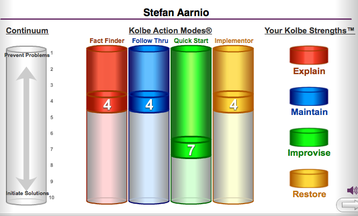
Kathy Kolbe is a theorist and educator who developed a test called the Kolbe index.

The Kolbe index is a series of short questions that measure your instincts show you what your strengths are when under pressure.

For myself, this information has been unbelievably helpful. It also explains why I am happiest under pressure.

The reason why I am happiest under pressure is because I am forced to become my natural self. 

Pressure brings out my natural instincts and allows me to pursue the "best version of myself".

My Kolbe index tells me that under pressure I "improvise". People with instincts similar to mine make great salespeople, public speakers, on camera people, radio hosts, interviewers, storm chasers, video game designers and non-conventional educators.

All of the above "careers" are high pressure, performance based career paths that require little or no formal training to achieve success.

This would explain why I am least happy in low-pressure situations and most happy in high-pressure situations. 

Pressure forces me to become who I naturally need to become.

Pressure is what turns coal into diamonds and it also turns a raw undeveloped average person into a refined success.

I would encourage you to take your Kolbe index and find out what your instincts are and find out how you work under pressure.

Find out what your natural skill sets are, where you are happiest and then focus your whole life and business around that skill set.

For myself, I need to "improvise" all day long to feel full-filled and happy. I have re-organized my entire business around myself being able to "improvise" while key team members around me handle all of the other tasks.

By pursuing this strategy, I have seen greater success, experienced more fun, and felt more excitement. All of this can be had from selecting the tasks and roles that excite my instincts.

Please take a moment to invest in yourself, learn about your instincts and harness your talents. You're worth it.

Thanks for reading,
Stefan Aarnio
Freedomway.ca
http://www.facebook.com/stefanaarnio

P.S. Please share this article if you found it helpful


1 Comment
<<Previous
Forward>>

    RSS Feed

    Stefan Aarnio

    Stefan Aarnio is a Real Estate Investor, entrepreneur and artist based out of Winnipeg, Manitoba.His real estate website is Freedom Way Joint Ventures  His art can be seen at http://stefanaarnioart.com

    View my profile on LinkedIn

    Archives

    October 2013
    September 2013
    July 2013
    April 2013
    March 2013
    February 2013
    January 2013
    December 2012
    November 2012
    October 2012
    September 2012

    Categories

    All
    Amateurs
    Art
    Authors
    Billion Dollar Business
    Branding
    Business
    Business Building
    Buyers
    Cash Flow
    Change
    Charity
    Coaching
    Connection
    Contractors
    Deal Partners
    Deals
    Decision Making
    Distributors
    Dragon's Den
    Dreams
    Economy
    Education
    Email
    Emotional Value
    Emotions
    Enthusiasm
    Entrepreneurship
    Evolution
    Fashion
    Fears
    Franchise
    Fundamentals
    Grit
    History
    Identity
    Industry
    Instant Equity
    Instant Profits
    International
    Intrinsic Value
    Investing
    Jobs
    Joint Ventures
    Leadership
    Marketing
    Missed Opportunity
    Money
    Mould
    Needs
    Negotiation
    Net Migration
    Networking
    Outsourcing
    Passion
    Passive Income
    People
    Persistance
    Philanthropy
    Power Team
    Producers
    Professional
    Professionalism
    Profits
    Raising Capital
    Real Estate
    Recession
    Return On Effort
    Return On Learning
    Return On Relationships
    Return On Time
    Risk Mitigation
    Self Employed
    Selling
    Shark Tank
    Social Status
    Speed
    Strategy
    Success
    Tactics
    Team
    Time Managment
    Traitors
    Unlimited Cash
    Value
    Venture Capital
    Vision
    Wages
    War
    Weakness

    RSS Feed

Powered by Create your own unique website with customizable templates.